Chủ Nhật, 3 tháng 10, 2021

SEO KPIs: The indicators to measure the success of the SEO campaign

You already know: To plan and execute an SEO campaign is not an easy task.

However, not only planning and execution means that all work is done. You need to continue to monitor the effectiveness, learn from mistakes, and constantly improve your campaign.

The best way to track the effectiveness of an SEO campaign is to focus on specific SEO KPIs. However, there are countless SEO KPIs you can approach, and not all of them will work for you.

Good SEO KPIs will help you throughout the campaign stages, even while the campaign is still running, ensuring you promptly recognize any warning signals at the earliest.

Are you ready to keep in mind the essential SEO KPIs for your campaign? Let's get It Started!

What are SEO KPIs?

SEO KPIs are metrics that marketers use to measure SEO effectiveness on websites. As a result, they can truly understand the effectiveness of each campaign, track any changes, and manage the full impact of algorithm updates.

kpi seo là gìWhat is the SEO KPI concept?

Here's how you define goals and KPIs for your SEO campaign.

Determining SEO goals and KPIs

To accurately measure the effectiveness of an SEO campaign, the first thing you need to know is: what is the specific goal that the campaign is aiming for.

The selected KPIs should ensure that they are mapped out against these goals. From there, it can clearly show how the top of the work you are undertaking in the SEO campaign towards the ultimate goal of the business.

If a client comes to you and asks to increase rankings for a bunch of keywords (listed earlier), then you need to dig deeper into the situation.

You need to ask questions:

  • Why? Why do you need these keyword rankings?

  • How can that help your business?

You need to develop your reasoning in the direction of:

  • Be strategic about why your customers need what.

  • The reason why they want to focus on ranking for that keyword, traffic from search engines.

  • Understand what their real business goals are.

vì sao khách hàng chọn gtvYou need to clearly understand what the customer wants, then give them a compelling reason.
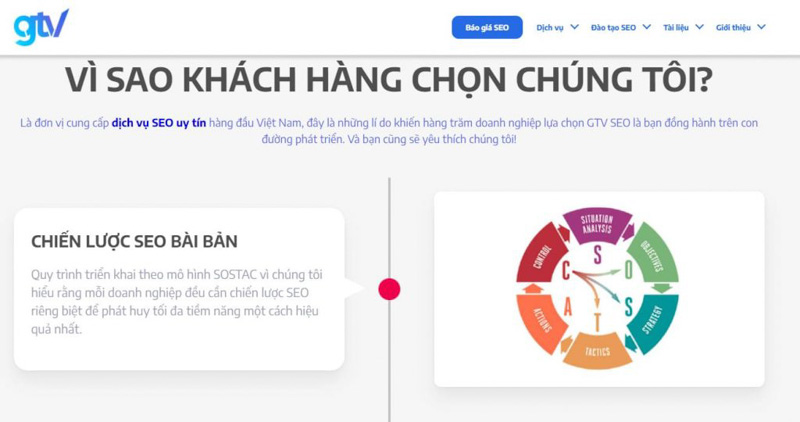
After understanding your client's real goals, beyond just achieving higher rankings for the keywords listed, you can provide better and more valuable service to them.

Most importantly, you can include KPIs that are directly related to your business goals. This means that KPIs will be rephrased in a language that people who make business decisions can also understand.

High keyword rankings are great. But the percentage that represents an increase in sales from implementing SEO or a reduced investment cost per lead will help you succeed and be more appreciated in the eyes of customers.

The SEO value needs to come with the conversion rate. And this is also the guideline that projects Hanoi SEO service at GTV always aim for.

Simply put, an SEO KPI is the link between your business goals and the SEO work you're doing.

Don't let the SEO KPI building process lead to "Analysis paralysis" results

Important note: We own a huge amount of data. Obviously the data presented in analytics programs like Google Analytics is overwhelming.

But trying to explain all of the metrics like Bounce Rate or frequency to a client can often be difficult. A glazed and bewildered look from your audience might be the image you'll get from meetings with clients.

Decision makers need what they understand: Clearer, granular data.

The audience you report on strategy for SEO services has 2 main groups to focus on:

SEO-er or analysts: They need deep research focused reports.

However, businesses: Just focus on key information that can be used to make decisions.

Therefore, if you provide the right information they need, as well as help solve the exact problem: Marketing costs, then they will be YOUR CUSTOMERS.

Don't confuse potential customers with your data.

Now, it's time for us to dive into the more important content. Please focus and remember the following information!

SEO KPIs for Agency

For an agency, the importance of SEO KPIs is fundamental. It helps to ensure that the work you implement will have a productive impact on your partner's business.

SEO is so confusing and complicated these days, the same thing that may work for one business may not work for another.

Therefore, you need to account for all the variables, carefully measuring the individual results of each with the overall strategy. Don't assume that just because certain types of links work for one job can get the same results for another.

The SEO KPIs you choose should be able to provide the earliest warnings if your SEO campaign is not achieving results. If you are not getting the results you want, you need to dig deeper and find out what the root cause is. Do not try to implement the project for 6 months and the problem still cannot have a correct answer.

Remember: SEO KPIs provide early warnings so you and your business can clearly identify potential problems and plan strategies to solve them in a timely manner. Use SEO KPIs internally to measure, review, and improve your approach where needed.

Business SEO KPIs

Whether your goal is just reporting or customer retention, you need to be able to clearly and precisely communicate why a certain strategy is in place.

Example: Why a blog post is necessary or why Digital PR is important.

Just explaining the ranking growth alone is never enough. Ranking growth is not synonymous with revenue growth. More connections are needed to clarify the relationship between the report and the stated end goal of the business.

You have to identify a certain tactic that is helping to improve the bottom line for the client and drive them towards their end goals.

Increase the number of potential customers, increase sales, increase customers, etc. there are many choices here that prove the true value of your work.

Make sure you clearly communicate this through your SEO KPIs outlined against your business goals.

More specifically, what SEO KPIs do you need, we will move to the content: How to classify SEO KPIs

Classification of SEO KPIs

In order for SEO KPI metrics to be best communicated, you should clearly categorize SEO KPIs .

Remember: The goal of launching a new product is completely different from the company's goal of trying to sell more to existing customers.

If you're a local business, an SEO campaign can be designed to get more customers to your store. If you're a service business, you'll likely aim to get as many leads as possible.

A new product can be expected to attract attention and generate an email list. Make sure to categorize and communicate SEO KPIs in the most meaningful way.

Realize that the marketing funnel can make it easier to categorize SEO goals and KPIs.

  • Awareness: Build an audience for your product or service.

  • Engagement: The goal of increasing engagement for your products and services.

  • Conversion: Target sales and leads.

VQVC: Volume, Quality, Value and Cost

Another useful way to categorize your SEO KPIs is with the “Value, Quality, Value and Cost” template.

  1. Volume: Unique Visitors, visits, page views…

  2. Quality: Bounce Rate, Visit Duration, Pages per visit

  3. Value: Financial value per visit/lead/conversion?

  4. Cost: How much does it cost to get 1 lead or one contract from SEO?

How GTV SEO uses SEO KPIs to measure the effectiveness of SEO strategies

Honestly, to effectively measure the results from SEO and Digital Marketing campaigns is a big challenge. There is a lot of data, but all of it when in metric format on analytics tools (like Google Analytics) is often more confusing than providing a concrete view.

These tools need to be customized to show specific goals, by looking at the desired results and linking them to your SEO strategy and SEO KPIs.

The SEO KPI report used at GTV is designed for more than just tracking the ranking of a small set of keywords. Instead, GTV SEO looks at the effects on Organic Traffic (awareness), Relevance of traffic (engagement) and overall quality, the likelihood that this traffic leads to contracts, potential partners or conversions anywhere. any form.

báo cáo kpi seo tại gtvHow GTV uses SEO KPIs to measure performance.
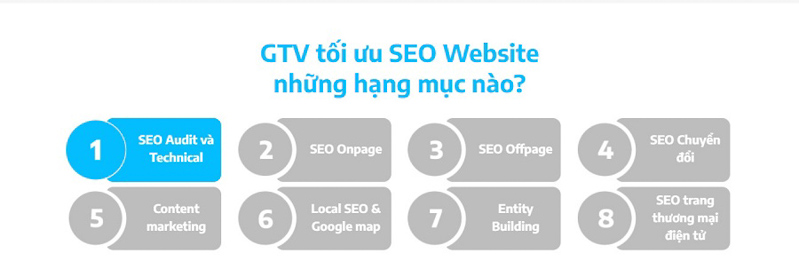
GTV SEO, also considers the actual results in the campaign: Usually content is created to increase topic coverage, links are built to increase authority and relevant Referral Traffic. Last but not least, GTV looks at traditional SEO metrics powered by tools like Moz and Majestic SEO.

And all is not such a fixed template that will still need to be customized based on the specific work and goals of the customer. All of the above is always aiming, 90% on the way towards improving SEO KPIs and reporting.

SEO metrics

There are traditional SEO KPIs that can be used to gauge progress, but these metrics will need to be compared with competitors to provide a realistic picture. Typically, an increase in a website's trust and authority will correlate with the ranking growth for search terms and the Organic Traffic received.

These metrics are important, but never express them in business terms – then the prioritization of the above metrics in the report will depend on how SEO-savvy the client is (here). which of course you should always aim to improve on).

  • Ranking for key converting keywords (local/organic).

  • Ranking for secondary benchmark keywords (local/organic).

  • Majestic Citation Flow.

  • Majestic Trust Flow.

  • Majestic Trust & Citation Balance.

  • Moz Domain Authority.

  • Moz Page Authority.

  • Moz Spam Score.

Realistic SEO KPIs

Here we see how what we're doing affects the entire website: Is

  • the strategy getting more traffic?

  • Is the implementation generating more pages that generate overall traffic, thus increasing topic coverage?

  • Does keyword visibility in search help increase traffic?

This is when SEO strategies become most realistic so these metrics are important.

dịch vụ seo chuyên nghiệp tphcmOffer realistic SEO KPI strategies.

  • Organic Traffic Growth.

  • Increase the number of pages on the site that generate traffic.

  • Non-branded search traffic growth.

  • Percentage increase in organic conversions.

  • Percentage of increased traffic from specific regions.

  • Organic Impressions (Search Console).

  • Organic Click-Through Rate (CTR) (Search Console).

Referral Traffic

A solid SEO campaign can have an impact on a business, beyond just driving more Organic Traffic. If links are an important part of your strategy, this exposure can drive more quality Referral Traffic.

It is therefore prudent to demonstrate additional value here, which helps illustrate how an SEO strategy has many marketing benefits, and regular Referral Traffic can convert higher than Organic Traffic – So ignore it. this when in danger.

  • The percentage in Referral Traffic increased.

  • The percentage in Referral Conversions increased.

  • The percentage in Engagement Metrics (bounce, pages, time) increases.

Brand Impact

Increasing search visibility is equivalent to increasing overall visibility. So GTV SEO also looks at the increase in branded search traffic and brand mentions and how it relates to the work being done.

  • The percentage in branded search traffic increased.

  • The percentage in brand mentions increased.

Link-building KPI

Linking remains one of the big three metrics for improving search engine visibility, and links (plus content) are often the key tangible element of a long-term SEO campaign.

Therefore, GTV SEO is still required to report on the overall number of links, links from authoritative sites and links from highly relevant sites. These are usually pulled from a wishlist of links and should be customized around the client's industry.

  • Total link built.

  • Number of links from authoritative sites.

  • Number of links from relevant sites.

Lead generation KPIs

Leads are an important component of the overall Digital Marketing activity.

kpi tạo khách hàng tiềm năngKPIs generate leads.

However, the classification of leads and sales funnels is becoming more and more complicated. Therefore, GTV looks at measuring the impact of previous SEO efforts on lead generation, whether it's social media signups, newsletter subscriptions, or some downloads or customer genes. Other potentials specific to your business.

  • The percentage of subscriptions to newsletters (e-newsletters, e-catalogs, etc.) increases.

  • The percentage of social media followers/likes… increased.

  • The goal of creating specific customers for the business (data sheets, white paper ...).

Really talking to customers about what the customer journey looks like and capturing their every step adds value to SEO strategies.

KPIs by specific business goals

This is a bit more difficult. However, it is important from a reporting perspective.

GTV SEO has really done all it can to connect business strategy with SEO strategy. The SEO KPIs detailed above are all used here, so it's a case of synthesizing the structure to match the client's already goals.

If the goal is to raise awareness of a new product, then GTV will focus on awareness metrics: Impressions, average position, keywords, clicks, etc.

If the goal is to promote multiple signups, then GTV SEO tracks the number of people visiting the registration and price pages.

Or the goal is more traditional conversions, the metrics to track are: Total sales, leads, customer demand.

Conclusion

Have you found the right SEO KPI for your strategy?

Don't forget, the work you're doing on your business's strategy is more valuable than simply ranking for keywords. That is, adding real value to the business, reducing marketing costs, branding and more. Just remember to let them know!

In addition, if you want more detailed advice for your SEO strategy, contact GTV SEO for a free consultation!

Good luck!

Source: https://gtvseo.com/kpi-seo/


#gtvseo #gtv_seo #kpi_seo

Thông tin liên hệ:
GTV SEO
Địa chỉ: Số 91, Đường số 6, Khu dân cư Cityland Park Hills, Phường 10, Quận Gò Vấp, TP. HCM
SĐT: 0919-009-319
Email: info@gtvseo.com

Thứ Sáu, 1 tháng 10, 2021

How to Use Structured Data to Support E-A-T

 Do you want to boost your content's perceived E-A-T? Learn how to leverage structured data to do that in this guide.

Google’s concept of “E-A-T” (Expertise, Authoritativeness, and Trustworthiness) has become a hot topic in the SEO community in recent years, as well as a source of many myths and misconceptions.

One of the most prominent questions and mysteries surrounding E-A-T is whether and the extent to which it is a direct ranking factor in Google’s algorithms.

However, Google has been consistent about the role E-A-T plays in both its algorithms and how it is used by search quality raters, stating that “Google’s algorithms identify signals about pages that correlate with trustworthiness and authoritativeness,” as opposed to E-A-T itself being a quantifiable, measurable metric used in Google’s algorithms.

To solidify this point, Google recently provided an update on this question, indicating that E-A-T is not in and of itself a ranking factor but rather a framework that encompasses the many signals Google uses to evaluate and rank great content.

In a March 2020 update, Google stated that:

“Assessing your own content in terms of E-A-T criteria may help align it conceptually with the different signals that our automated systems use to rank content.”

Google’s communications about E-A-T leave a lot of room for interpretation and debate, which tends to result in one common question among many SEO professionals:

If E-A-T is so important, how can I optimize my content to improve its perceived E-A-T?

While Google’s official answers to questions related to E-A-T leave many SEO professionals uncertain on what next steps to take, there is one reliable, underutilized method we can use to improve not only E-A-T, but also overall organic performance: leveraging structured data (Schema.org) to its fullest capacity.

How Structured Data Can Help With E-A-T

Proper use of structured data can help with E-A-T for a number of reasons.

For one, structured data helps establish and solidify the relationship between entities, particularly among the various places they are mentioned online.

In Google’s own words, providing this markup “helps” them by “providing explicit clues about the meaning of a page” that Google then uses to “understand the content of the page, as well as to gather information about the web and the world in general.”

Using structured data to establish these relationships can streamline Google’s ability to assess the E-A-T of a given page, website, or entity because it can help:

  • Reduce ambiguity among entities.
  • Create new connections Google wouldn’t have otherwise made in its Knowledge Graph.
  • Provide additional information about an entity that Google might not have obtained without the structured data.

According to Knowledge Graph and Google patent expert Bill Slawski:

“Structured data adds a level of preciseness that a search engine needs, and might not grasp, because it doesn’t have the common sense of a human.”

Without confidence about what entities are included on a page, it can be challenging at best for search engines to accurately assess the expertise, authoritativeness, and trustworthiness of those entities.

Structured data also helps to disambiguate entities with the same name, which is undoubtedly important when evaluating E-A-T.

Slawski provided a couple of interesting examples of how this might work:

“When you have a person who is the subject of a page, and they share a name with someone, you can use a SameAs property and point to a page about them on a knowledge base such as Wikipedia to make it clear that when you refer to someone like Michael Jackson, you mean the king of pop, and not the former Director of Homeland Security – they are very different people.

Businesses sometimes have names that they might share with others, such as the band Boston, which shares a name with a city.”

Structured data essentially serves as a way of spoon-feeding Google crucial information about the topics on your site, as well as the individuals who contribute to it.

This is a crucial first step in Google then being able to accurately assess the trustworthiness and credibility of your site and the creators of its content.

Implementing Structured Data for E-A-T

There are a few different methods of implementing structured data: JSON-LD (which is preferred by Google), Microdata, and RDFa.

Google has also recently added documentation on adding structured data dynamically using JavaScript and Google Tag Manager.

For WordPress websites, the popular SEO plugin Yoast has many built-in Schema capabilities and has been actively expanding on new Schema types and features in recent months.

For the purpose of improving E-A-T, the method of implementing structured data is less important than the types of Schema marked up on the website.

Improving E-A-T requires giving search engines as much information about the credibility, reputation, and trustworthiness of the authors and experts who contribute content to your website and who make up your company.

E-A-T also encompasses your brand’s reputation and the experience users have both on your website and when using your products or services.

These aspects are particularly important to mark up with Schema whenever possible.

It is also crucial to properly structure your Schema so that search engines can understand the various properties of a given entity and the relationship between them and other entities.

Alexis Sanders offers a fantastic explanation of the benefits of nesting Schema and how to do it correctly in this article about JSON-LD.

For example, the Schema shown below comes from my personal website’s homepage and demonstrates how nesting looks when done properly.

(This was done by setting my site settings to a “Person” using the Yoast plugin, and filling in all relevant fields on my profile.)

Proper nesting of Schema makes it so you can:

  • Essentially read the resulting Schema aloud from the Structured Data Testing Tool.
  • Get an understanding of the main entities on the page, as well as their relationships to one another.

Nesting also eliminates the common issue of having multiple redundant or conflicting Schema types on the same page (often due to having multiple plugins injecting Schema simultaneously).

On a product page, for example, it’s important to clearly describe and differentiate the relationships between the Organization which publishes the website, and the Organization which manufactures the product.

By placing those correctly in a nested structure, you can clearly describe the difference in their roles – rather than just saying that both of them are “on the page.”

Which Schema Types to Use to Improve E-A-T

There are a variety of Schema types and properties that are crucial to have present on your website to send the right signals to search engines about your organizations’ E-A-T.

Below are five examples of some of the highest-priority opportunities to use Schema to signal good E-A-T, but there are many more where this came from.

1. Person Schema

Google’s first mention of E-A-T in its Quality Rater Guidelines starts by asking raters to consider “the expertise” as well as “the authoritativeness of the creator of the main content.”

This information can be communicated to search engines through the use of Person Schema.

This Schema type includes dozens of options for properties to be listed to provide more context about the person, many of which strongly support E-A-T, including (but not limited to):

  • affiliation
  • alumniOf
  • award
  • brand
  • hasCredential
  • hasOccupation
  • honorificPrefix
  • honorificSuffix
  • jobTitle
  • sameAs

Consider including Person Schema with the above properties at least once where your founder, content creators, and/or expert contributors are listed on your site.

(Assuming this information is also displayed on the page – which is a prerequisite for structured data compliance.)

An author biography page is a good candidate for featuring this Schema type.

2. Organization

Organization Schema is undoubtedly one of the best Schema types to support E-A-T efforts.

This Schema type offers a variety of properties that can provide additional context about your company or brand, for example:

  • address
  • duns
  • founder
  • foundingDate
  • hasCredential
  • knowsAbout
  • memberOf
  • parentOrganization

Many companies implement Organization Schema without leveraging these fields or the many other properties available using this Schema type.

Consider incorporating all of this information into your most relevant page about your organization (generally an “About Us” or “Contact Us” page) and marking up the page accordingly.

3. Author (Schema property)

Author is a Schema property that can be used for any Schema type that falls under the CreativeWork or Review classification, such as Article or NewsArticle.

This property should be used as markup for the author’s byline on a piece of content.

The expected types for the Author property are either a Person or Organization, so if your site publishes content on behalf of the company, it’s important to list the author as an Organization and not a Person.

4. ReviewedBy (Schema property)

The property reviewedBy is a great opportunity to showcase your website’s good E-A-T.

If you use expert reviewers on your content, such as medical or legal reviewers, consider displaying their name on the page as the individual who has reviewed your content for accuracy.

Then, you can leverage the reviewedBy property to list that person (or organization)’s name.

This is a great approach to use if your authors may be lacking E-A-T or a strong online presence, but your reviewers are the true experts with a known online presence.

For WordPress to websites using Yoast, a reviewedBy feature is currently being considered for their roadmap, which will allow you to indicate the individual who has reviewed your content by selecting among your authors in WordPress.

5. Citations (Schema property)

Using the citation Schema property, you can list the other publications, articles, or creative works your content cites or links to.

This is a great way to show search engines that you are referencing authoritative, trustworthy sources to support your work, which is a great strategy for E-A-T.

Furthermore, listing citations in Schema markup can help position your brand in relation to the other brands you associate with, which can potentially provide Google with qualitative information about your trustworthiness.

SEO TỔNG THỂ VÀ SEO TỪ KHÓA: ĐÂU LÀ SỰ LỰA CHỌN TỐT NHẤT?

🤷Bạn vẫn thường nghe qua hai loại chiến lược SEO tổng thể và SEO từ khóa. Thế nhưng bạn vẫn chưa thật sự hiểu rõ về 2 chiến lược này, nó khác nhau như thế nào?
🤷Bạn vẫn cứ hoang mang không biết nên lựa chọn loại chiến lược nào để đem lại hiệu quả tốt nhất cho doanh nghiệp của mình?
🔥Tất tần tật câu trả lời bạn cần sẽ được giải đáp tại đây. Bài chia sẻ dưới đây sẽ giúp bạn hiểu được bản chất của SEO tổng thể và SEO từ khóa, từ đó bạn có thể đưa ra lựa chọn chính xác nhất cho doanh nghiệp mình. Xem ngay nào!

#gtvseo #gtv_seo #seo_tổng_thể_và_seo_từ_khóa

Thông tin liên hệ:
GTV SEO
Địa chỉ: Số 91, Đường số 6, Khu dân cư Cityland Park Hills, Phường 10, Quận Gò Vấp, TP. HCM
SĐT: 0919-009-319
Email: info@gtvseo.com

Overall SEO vs Keyword SEO: Which is the Best Choice?

 Your business is struggling to know which SEO service to choose. 

  • Overall SEO or Keyword SEO, what's the difference?

  • Which would be the most suitable choice for your business right now?

All the answers you need will be answered here. In this share, I will help you understand the essence of overall SEO services and keyword SEO services, so that you can make the most accurate decisions for your business.

Are you ready? Start learning now!

As with any learning process, we will start with the most basic concept.

Overall SEO and KeywordConcepts

SEOWhat is Overall SEO?

You can understand overall SEO as the process of optimizing the user experience and helping Google understand the website content most accurately. This strategy is implemented by analyzing search needs, optimizing websites by topic clusters based on user queries. The ultimate goal is to increase traffic, increase conversions.


What does overall website SEO mean?

To make it easier to understand SEO Overall, imagine you are running a website selling iphone. Your main keyword will now be “iPhone Phone”.

Next, we go deep and find that customers have searched around for keywords about iphone such as: Phone iphone 12; Phone price iphone 12; Store selling iphone 12 phones in Ho Chi Minh City, …

Deeper, when your business performs overall SEO, it will optimize the keywords "iPhone phone" - Main keyword; “iPhone 12” – Medium keyword; “Shop selling iPhone 12 phones in Ho Chi Minh City” – Long keyword (with high conversion rate).

This means that overall SEO will include all short keywords to long keywords. A process that requires developers to have specialized skills and in-depth research experience in each field, to be able to SEO the website in the most perfect way.

What is keyword SEO?

This is considered a traditional SEO strategy. The process of implementing the Keyword SEO Strategy will only focus on bringing the short keywords of the business website to the TOP. The goal is to increase the user's primary keyword traffic.

You can also understand, the task of keyword SEO is to help top some keywords. Usually the main keywords will be the keywords that businesses choose to rank at the top of the search.

This method will work on keywords that have a large search volume and a small number of keywords.

For example: Phone iphone, iphone 6, iphone 8, ...

By now you have understood the basics of these 2 SEO methods, right? Let's move on to the next important thing.


Keyword SEO strategy will only focus on bringing the short keywords of the business website to the TOP

The difference between overall SEO and keyword SEO

In this content, I will compare the two methods in detail according to each of the following criteria: Keyword, platform, cost, maintainability, traffic volume, preference points and disadvantages.

Based on the above analysis, it is also easy to realize that overall SEO brings superior benefits. However, every method has its own pros and cons and depending on the criteria your business will make the most suitable choice.

If you are still a bit confused about your choice, then watch the next content to be able to make a final decision! 

Which SEO method is best for your business?

Small Business – Startup

If you are doing a single item business, have a limited budget, need quick results and your business branding goals are not high, keyword SEO is the best choice. Because within only 2-3 months, the business website can be quite stable on the search engines and continue to maintain the SEO strategy.

Medium and large medium and large

enterprises Or Enterprises, with large capital, stable human resources and high-demanding brand goals, the best choice for businesses is always Overall SEO.

Because it will help businesses build a strong website foundation, expand markets, attract potential customers and help businesses grow stronger and win the full trust of customers.

Depending on the type of business, you choose the most suitable SEO strategy

Next, let's see how GTV SEO applies overall SEO to projects!

How GTV SEO applies the overall SEO strategy to projects

As a leading overall website SEO service provider in Vietnam. GTV SEO is always proud that the overall SEO strategy is the solution to help your business website develop comprehensively, become a sustainable sales channel, increase conversions and revenue!

And this is the reason why hundreds of businesses choose GTV SEO as a companion on the path of development:

  • Methodical SEO strategy

  • Pioneering website SEO method

  • Always focus on conversion

  • optimization Advanced and safe SEO techniques

  • Items are always detailed and transparent

  • Focusing on user experience

Here are some projects that GTV SEO has implemented and here are the results after the project ended.

Bamboo Airways

Current status of Bamboo Airways website before implementing SEO Strategy at GTV SEO:

  • The website structure is not standard

  • UX-UI, the booking function is still simple to attract and optimize users when experiencing the booking service. On the website,

  • Technical There are many Tech errors arising, because the International SEO part has not been set up well

  • Offpage, the website's RD is on par with the competition (750 RD), but the opponent's link is going evenly, the competitiveness is not high

Results Finally, the Bamboo Airway website achieved after implementing overall SEO:

  • Website traffic achieved more than 1,200,000

  • Keywords reaching Top 10 accounting for 42%

  • Keywords reaching Top 5 accounting for 27%

  • Keyword reaching Top 3 accounting for 12%

ImmiCa

Before deploying The overall SEO implementation of the Immica website had the following problems:

  • Content: heavily duplicated and missing

  • Onpage: not yet implemented

  • Internal Link: not yet implemented

  • Technical: error

  • UX, UI: must be redesigned because standards are not met. of the market

  • Offpage: there are more than 900 low-quality domains

After implementing the SEO strategy Overall website Immica has achieved the following results:

  • Traffic reached 12,000/month

  • Keyword reached Top 5, accounting for 80% The

Join GTV SEO to improve your website breakthrough

above is how GTV SEO applies the overall SEO strategy for Bamboo Airways and Immica. So how much budget is okay when you decide to go with a professional overall SEO Agency? Check out SEO service price GTVlist for more information!

Conclusion

As I share, the main goal of every SEO method is to help businesses get closer to potential customers, increase revenue and develop sustainably. Therefore, when choosing an SEO strategy, you should comprehensively consider relevant factors, financial as well as business resources.

Hopefully, sharing about overall SEO and keyword SEO will help you easily determine the right SEO method for your business.

Have you made your final decision yet?

If you still have not determined which SEO method is suitable, contact GTV SEO for a free consultation.

Source: https://gtvseo.com/seo-tong-the-va-seo-tu-khoa/


#gtvseo #gtv_seo #seo_tổng_thể_và_seo_từ_khóa

Thông tin liên hệ:
GTV SEO
Địa chỉ: Số 91, Đường số 6, Khu dân cư Cityland Park Hills, Phường 10, Quận Gò Vấp, TP. HCM
SĐT: 0919-009-319
Email: info@gtvseo.com